General play tips, not veterinary advice. Every pet is different, so check with your vet if you have concerns.
Indoor hide and seek games for dogs can give a gray November evening a small, shared project: find one familiar toy in one manageable room. The useful part is the search you can set up together, with an obvious first success and room to stop. You don’t need to scatter food around the house or turn the furniture into an obstacle course.
This guide follows one toy from an easy, visible placement to a simple out-of-sight hide. It is a different activity from introducing a snuffle mat. For an overview of the available formats, visit our hide-and-seek guide; here, we’ll work through the actual room setup, the reset between finds, and what to change when the game gets stuck.
Choose the room before choosing the hiding place
Start in a familiar room where you can see your dog throughout the search. Move shoes, children’s toys, loose packaging, and anything you don’t want investigated out of the search area. Close access to stairs and rooms that aren’t part of the game. Keep the route on one level, with a stable, nonslip surface and enough space to turn without bumping furniture.
Keep seasonal decorations and wrapped gifts outside the search zone. A toy hidden beside a gift bag can make the wrong object part of the activity. Choose a plain stretch of floor or the open side of a sturdy chair instead of a shelf full of tempting objects. Don’t wedge the toy under furniture, behind a heater, inside a cabinet, or anywhere your dog would have to climb, squeeze, or pull things apart.
Winter plans still need to suit the individual dog. MSPCA-Angell’s cold-weather guidance discusses differences in cold tolerance and options for indoor activity. A living-room game is an addition to an appropriate daily routine, not a promise that searching replaces walks, bathroom breaks, or an exercise plan from your veterinarian.
Pick a toy your dog can safely find and enjoy
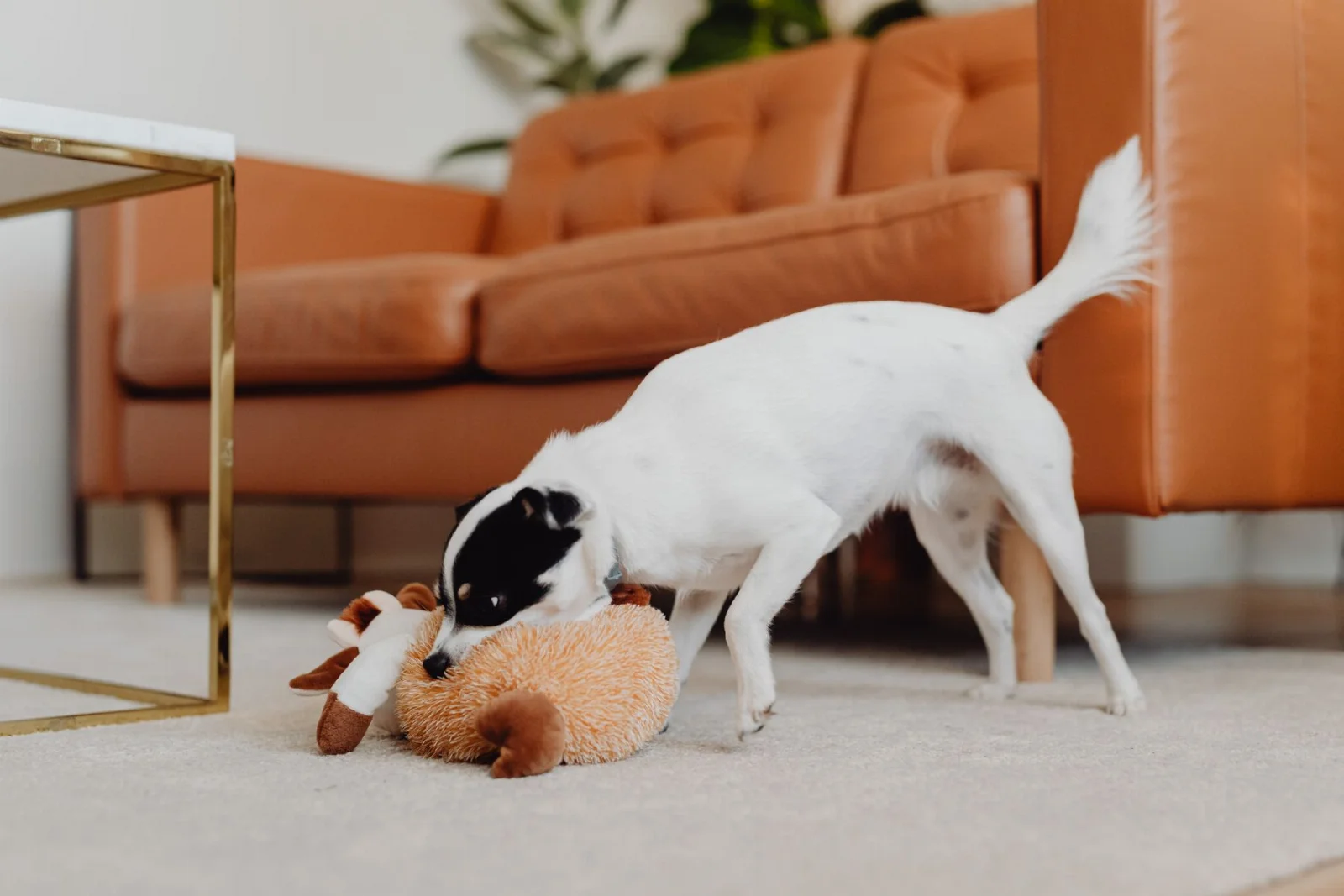
Use a familiar dog toy that your dog already likes and can comfortably handle. Check it before the first round, including seams and any attached parts. Skip objects that are too small, already damaged, or likely to be torn into pieces. The ASPCA’s guidance on choosing toys and chews emphasizes matching the item to the animal’s size and chewing habits and avoiding pieces that can be swallowed.
If you’re comparing a pocket format, Hide & Hunt Pockets has a soft play scene with removable plush toys. Select the dog edition and check the fit of each piece for your dog. The product’s guidance says it is not suitable for strong chewers. Its removable parts are not a reason to use a smaller cat-edition piece with a larger dog.
A toy your dog wants to carry may suit a room search better than one they immediately settle down to dismantle. You can also keep discovery within the pocket scene rather than hiding its pieces around the room. These are separate setups: start with the one your dog already understands. The hide-and-seek collection compares a pocket scene with a tunnel; you don’t need both for this game.
Round one: let your dog see the answer
The American Kennel Club includes finding hidden toys among its indoor activities. Your first placement can be much simpler than a proper hiding spot. Put the toy in the open, a short distance away, while your dog watches. Say a brief cue such as “Find your toy,” then give them a moment to approach it.
- Show the chosen toy without waving it into a chase.
- Set it on clear floor where your dog can see it.
- Give your cue once, in your usual friendly voice.
- Let your dog reach it without repeatedly repositioning it.
- Offer quiet praise and room to enjoy the discovery.
If your dog looks at you instead of moving toward the toy, walk a little closer to the placement and point beside it. You aren’t spoiling the game by helping. If there is still no interest, pick a different familiar toy on another occasion or finish for now. Don’t keep repeating the cue or tapping the toy against your dog.
A find doesn’t have to end with a retrieve. Your dog may nose the toy, pick it up, or stay beside it. You can acknowledge that discovery without asking for another behavior. Decide what counts as success before you start, so a dog who finds the toy doesn’t face a surprise demand to bring it across the room.
Make one small change at a time
Once the open placement makes sense, change either the position or the visibility. For example, put the toy beside the same chair but leave part of it showing. On another round, place it just around the chair’s open edge, with an easy route to it. Keep the rest of the room and your starting position familiar.
There is no need to add distance, a new room, and complete concealment together. If a placement leads to searching the wrong furniture, return to a visible toy on the floor. Move it away from the confusing location rather than encouraging your dog to investigate deeper. Keep every hiding place somewhere you would be comfortable having your dog look again later.
A reliable stay can be useful, but it isn’t an entry requirement. A second adult can keep your dog company while you set the toy down, provided your dog is comfortable with that arrangement. Otherwise, let your dog watch. If waiting behind a barrier causes distress, simplify the setup instead of turning the pause into a training test.
Use the reset as part of the game
Before you plan another hide, notice what happens after the find. Does your dog return toward you, stay with the toy, or leave the area? If they enjoy holding it, allow a supervised pause. A second suitable toy can make a familiar, voluntary exchange possible, but don’t introduce a trade your dog hasn’t learned in the middle of a difficult search.
Don’t chase a dog who carries the toy away or pry it out of their mouth. The AKC’s guide to trading items explains why forcing a release can create problems and why an established exchange is preferable. If your dog doesn’t want to release this toy, you can end the search while continuing to supervise them with it.
Stiffening over an item, growling when approached, or snapping calls for a different plan, not a harder hiding place. Give space and keep children away from the situation. The AKC’s resource-guarding guidance recommends professional help and veterinary assessment when behavior changes. Don’t try to work through guarding with this game.
When a search stalls, make the next choice easier
- Your dog watches your hands. Set the toy down in full view again. You may have changed the hiding place before the first placement was clear.
- Your dog searches everywhere except the toy. Reduce the search area. Remove nearby objects rather than adding louder encouragement.
- Your dog paws at furniture. Stop using that location. Return to an open-floor placement so furniture doesn’t become something to dig through.
- Your dog takes the toy and rests. Let that be the finish. Finding it can be enough; another round is optional.
- Your dog tries to tear it apart. Stop the activity and follow the item’s safety guidance. Don’t keep using a damaged toy to preserve the game.
For a dog with mobility limitations, ask your veterinarian what movements and surfaces are appropriate. The AKC’s senior-dog play guide describes adapting hide-and-seek to health and interests. Don’t assume that a floor-level game is suitable for every dog simply because it looks gentle.
Keep a tiny record, then put the setup away
After a few easy finds, offer a break. You don’t need to reach a particular number of rounds or produce an exhausted dog. Put away toys your dog cannot safely have without supervision, following the chosen item’s care instructions. Count removable pieces before storing the set. Use its stated cleaning guidance rather than assuming plush parts can go through a washing machine.
A useful note for next time is simply: toy chosen, placement used, help needed, and how your dog finished. “Toy visible beside the chair; one point; carried it to the rug” gives you a clearer starting point than “too easy.” If your dog was comfortable, repeat that same arrangement before trying something new.
Our beginner enrichment guide can help with the wider routine. For this particular winter game, keep the task modest: a toy worth finding, a room that is safe to search, and a person who is happy to stop while the invitation still feels comfortable.
These are general play tips, not veterinary advice. Ask your veterinarian about your dog’s individual needs, health, or exercise restrictions.
Questions and answers
Can we play without treats?
Yes, if finding and interacting with a familiar, suitable dog toy interests your dog. Start with a visible placement and allow a supervised pause after the find. If the toy is not interesting, stop or choose a different activity rather than making the search harder.
Does my dog need to know stay first?
No. Your dog can watch you set the toy down. A second adult can help with the setup if your dog is comfortable with them. Keep the wait easy; don’t use a barrier or restraint that causes distress.
Does an indoor search replace a winter walk?
No. Treat it as an additional activity within a routine that includes bathroom breaks and appropriate exercise. Ask your veterinarian about your dog’s needs and safe activity when weather or health limits the usual plan.